

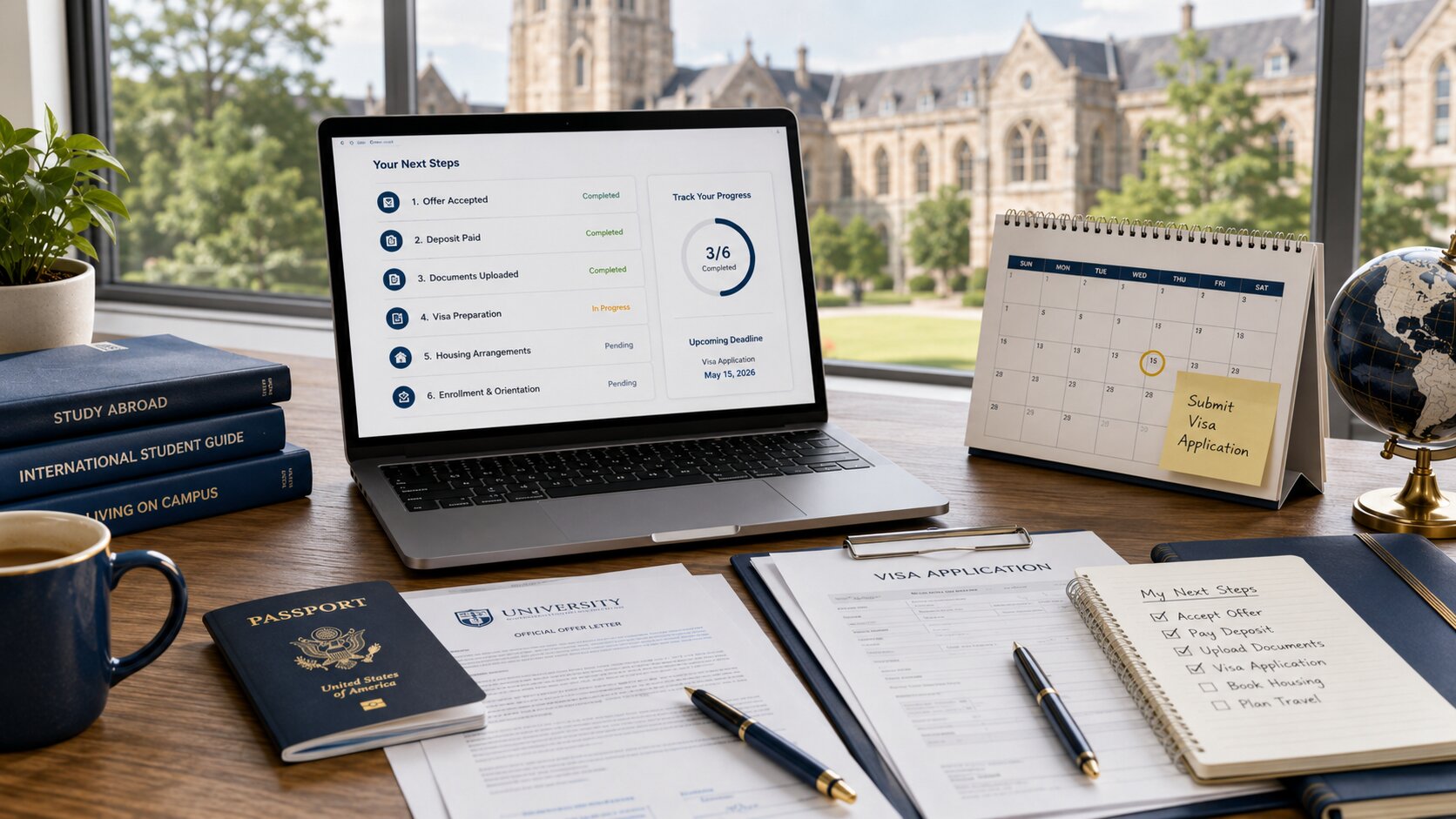
The offer has arrived. You have reread the letter several times, sent it to your family, and breathed a sigh of relief. But within a few hours a new list of questions appears: "What happens next? Do I need to reply? Is there a deadline? When do I pay the deposit? And when should I deal with the visa?"
Most applicants see the university invitation letter as the finish line of the admission campaign. This is the first mistake. It is exactly here – between the admission letter and the first day of study – that the greatest number of places are lost: because of missed deadlines, incorrectly read conditions, and documents submitted at the last minute.
Below is a clear action plan: what to check in the university letter, how to confirm your place, and which documents to prepare at each stage for successful enrollment.
Receiving an Offer From a University Abroad Is Not the Final Stage of Admission
What Are Conditional and Unconditional Offers, and How Do They Differ?
When the admissions committee makes a positive decision on an application, it sends one of two types of offers.
A conditional offer means the place is reserved conditionally. The university is ready to accept the applicant if specific requirements are met:
- Pass final exams with specific results – A-Levels, IB;
- Provide a school certificate or diploma;
- In some cases, complete an interview, send additional materials, or pay a deposit.
If the results are lower than required or the documents are not received on time, the offer may be withdrawn without warning and the place will go to the next candidate on the waiting list.
An unconditional offer confirms admission to the university. All documents have been checked, and the applicant's place on the program is secured. But even in this case, it is too early to relax: the deposit, visa documents, registration, and housing are still ahead.
Many applicants confuse the stages of "almost accepted" and "already a student." The difference between them may be just one or two documents, but the consequences are fundamental.
Why an Offer Is Not the Last Stage of Admission Abroad
Before the first day of study, several mandatory steps must be completed, each with its own deadline:
- Accept the offer – through UCAS, the personal account, or a reply email. The method and deadline are stated in the letter.
- Pay the deposit – a reservation payment that secures your place. Without it, the place is not secured even if confirmation has already been sent.
- Fulfill the conditions of the conditional offer – final results and documents must be provided strictly by the stated deadline.
- Apply for a student visa – CAS, I-20, CoE, or an equivalent document, financial documents, insurance.
- Complete registration – some universities request additional forms for housing and orientation events.
Missing one stage means putting successful admission and everything already done at risk.
What to Do After Receiving an Invitation to Study: First Steps
How to Read an Invitation From a University Abroad
An offer letter is a legally significant document with specific conditions and deadlines. Most applicants read it diagonally and miss details that later turn into problems.
Open the letter and check the following in order:
- University and program name – make sure the offer is for the major you selected.
- Offer type – conditional or unconditional: this determines the entire further action plan.
- Conditions of the conditional offer – write down every university requirement with exact numbers and dates.
- Confirmation deadline – missing it means losing the place automatically.
- Deposit amount and payment method – sometimes it is stated immediately, sometimes it arrives in a separate email.
- Contact details of the coordinator or admissions office – save them immediately: this is your direct communication channel for any questions.
If the offer came through a platform – UCAS, Common App, or the university portal – save it locally. Correspondence with the admissions office may be needed for the visa application.
Application and Response Deadlines: When to Reply to an Offer So You Do Not Lose Your Place
The response deadline is not a suggestion. If it is missed, the university can pass the place to the next candidate without negotiation.
Deadlines depend on the country and admission system:
United Kingdom – UCAS:
- All decisions received by March 31 -> the confirmation deadline is usually in early May.
- Offer received later -> three weeks from the date of receipt.
- Exact dates are in the UCAS account, not from memory.
United States:
- Most programs – May 1 (National Decision Day).
- Early Decision and Early Action have their own deadlines, stated in the letter.
Canada, the Netherlands, Australia, and others:
- There is no unified system; the deadline is always written in the letter.
- The standard range is from two weeks to two months from receipt.
The logic "the deadline is in May, so I'll reply in April" does not work: popular programs may close enrollment before the official date. Confirm within a week of receiving the offer and add the date to your calendar with a reminder seven days in advance. This gives you enough time to deal with technical confirmation details and deposit payment if something goes wrong.
How to Accept an Offer and Officially Confirm the Application
The process depends on the platform through which the documents were submitted.
UCAS (United Kingdom):
In your personal account, choose a response for each offer:
- Firm choice – your main choice.
- Insurance choice – a backup option with a lower entry threshold.
- Decline – refusal.
After your choice, the system automatically declines the remaining offers.
Common App / U.S. university portals:
Confirmation is not completed through Common App, but on the website of the selected university: the Accept offer or Enroll button. After acceptance, the deposit is paid through the same portal.
Direct applications (Canada, Australia, other countries):
The procedure is described in the offer letter – usually in the personal account on the university website: Accept -> confirm details -> deposit.
After confirmation, you should receive an email with further instructions. If nothing arrives within two business days, write to the admissions office. Technical failures happen, so it is better to make sure your response has been recorded in the system.
Which Documents to Check After Receiving a Conditional Offer
Open the offer letter and write down every condition with exact figures and dates. Do not rely on memory.
Academic requirements:
- Minimum score in final exams – A-Levels, IB.
- Final grade in specific subjects.
- Sometimes – a diploma with honors or a specific GPA.
Language certificates:
- IELTS Academic or TOEFL iBT results with a minimum overall score.
- Often there are requirements for each skill separately: for example, no lower than 6.0 in each IELTS component even with an overall score of 7.0.
- The certificate must be received before the deadline; simply taking the exam is not enough.
Education documents:
- School certificate or diploma with notarized translation.
- Transcript with the official seal of the educational institution.
Additional conditions are less common:
- Portfolio for design, architecture, art, and creative programs.
- Medical certificate or vaccination confirmation.
- Recommendation letter if it was not submitted at the application stage.
Read the wording literally. "Minimum IELTS 6.5" and "Minimum IELTS 6.5 with no band below 6.0" are different conditions. The second is violated most often: the applicant receives the required overall score but fails one component – and the offer is withdrawn.
For each unfinished requirement, set a completion date with a two-week buffer before the university's official deadline.
What Happens If You Do Not Meet the Conditions on Time
The university has the right to withdraw the offer – and in most cases this is exactly what happens, without reminders.
If you understand that the risks are high and you may not meet the deadline:
- Contact the admissions office before the deadline – explain the situation and ask whether an extension or adjustment of the conditions is possible.
- In the United Kingdom, if you have not met the required offer grades, you do not necessarily have to wait until the next year: through the Clearing system you can find an available place on a program with lower requirements. But a place is not given automatically – you must search for it and confirm it yourself.
Universities are more willing to help those who contact them proactively. Silence is interpreted as a lack of interest from a potential student.
Submitting Documents and Receiving Confirmation From the University
First, clarify the format requirements: a mismatch is one of the main technical reasons for delays.
What future students are usually required to provide:
- Documents in PDF, not JPEG.
- Notarized translation for documents not in English.
- Official seal on transcripts and certificates.
- Language certificates only through official channels: IELTS eDelivery, TOEFL Score Reporting; copies are not accepted.
Upload procedure through the personal account or student portal:
- Find the "Upload documents" or "Fulfill conditions" section.
- Upload each file separately with the correct name.
- Check the status: the document should be marked "Received" or "Under review."
- Save screenshots of the confirmation.
If you send documents by post, use tracked delivery only, with the recipient's signature. Originals sent without tracking can be lost, and it is almost impossible to prove that they were sent.
After uploading, write a short email to the university admissions office listing exactly what has been submitted. The official status change from conditional to unconditional usually arrives within two to four weeks. If it takes longer, request the status directly.
Unconditional Offer: Which Documents a Future Student Should Prepare
The absence of conditions in the offer does not mean the absence of documents. The visa process, university registration, and housing arrangements require a standard package – the earlier it is ready, the easier the final month before departure will be.
Passport
Check its validity period. Most countries require a passport valid for at least six months after entry – ideally for the entire period of study plus a buffer. If it expires within the next year, apply for a new one now: replacement takes from two weeks to a month.
Financial Documents for the Visa Stage
To obtain a visa, provide the consulate with:
- A bank statement for three to six months.
- A certificate of income from parents or a sponsor.
- A sponsor letter confirming willingness to pay for tuition and living expenses.
- If there is a scholarship – an official letter from the organization.
Final Academic Documents
Even with an unconditional offer, the university may request a school certificate or diploma for the student file – not as an admission condition, but as part of the registration package. Prepare it with a notarized translation.
Medical Documents
- Vaccination confirmation – a number of universities in the U.S., Canada, and Australia require it before campus housing move-in.
- Insurance – in some countries it is included in tuition, while in others it is arranged independently. In the United Kingdom, the Immigration Health Surcharge (IHS) is paid when applying for the visa; it grants access to the NHS healthcare system.
Additional Documents for Registration and Housing
- Passport-style photo for a student ID;
- Proof of address if you are not living in a dormitory;
- Bank details for scholarship payments or automatic payments;
- Housing application – submitted separately and with its own deadline, which often comes earlier than the visa deadline.
The complete list of documents for the admissions office is usually in the "Incoming students" or "Pre-arrival checklist" section of the university website. Check it immediately after accepting the university offer.
How to Turn the Dream of Studying Abroad Into Reality
An offer from a foreign university is the result of months of preparation: choosing a program, collecting documents, writing essays, and waiting. Losing a place because of a missed deadline or a misread condition would be unfair.
The whole process comes down to three principles:
- Be attentive and methodical. Write down the offer type, conditions, deadlines, and coordinator contact details immediately, and keep them in front of you until the visa is received.
- Do not leave everything until the last moment. Visa documents should be submitted when there is time to correct mistakes, not when it is already urgent.
- Communicate if something goes wrong. An applicant who explains the situation in advance has a chance of finding a solution. Someone who silently misses a deadline does not.
When Consultation and Help With Admission Abroad Are Needed
Not every case fits a standard algorithm. Sometimes a conditional offer contains requirements that are difficult to interpret without experience, or the scores turn out to be lower than required – and it becomes necessary to quickly understand whether it makes sense to negotiate with the university or look for an alternative.
In such situations, searching for answers online often provides outdated or inaccurate information. Rules change, and what worked for a student two years ago may no longer work.
Professional support after the offer stage helps applicants avoid wasting time on mistakes that others have already made.
If you have received an offer and are not sure about the next steps, book a consultation. We will analyze your specific situation: offer type, conditions, deadlines, and visa route for your destination country.
Final Checklist: What to Do After Receiving an Offer
We have prepared a step-by-step algorithm for applicants that helps avoid the most common student mistakes:
- Identify the offer type – conditional or unconditional;
- Write down all conditional offer requirements with dates and figures;
- Add the confirmation deadline to your calendar with a reminder seven days in advance;
- Accept the offer through UCAS, a portal, or the application platform;
- Pay the deposit on time;
- Fulfill the offer conditions, collect the full document package, and send it with confirmation of receipt;
- Receive the invitation document – CAS, I-20, CoE, or equivalent;
- Check passport validity;
- Collect financial documents for the visa stage;
- Apply for the visa with time to spare;
- Apply for a place in student housing;
- Arrange medical insurance.
Applying to the best universities in the United States, the United Kingdom, and Europe is a serious decision. What you do in the first weeks after receiving an offer determines whether that letter becomes a real student ID.
Received an offer and not sure what to do next? An AcademX mentor will help you build a clear action plan for deadlines, documents, and the visa.
