

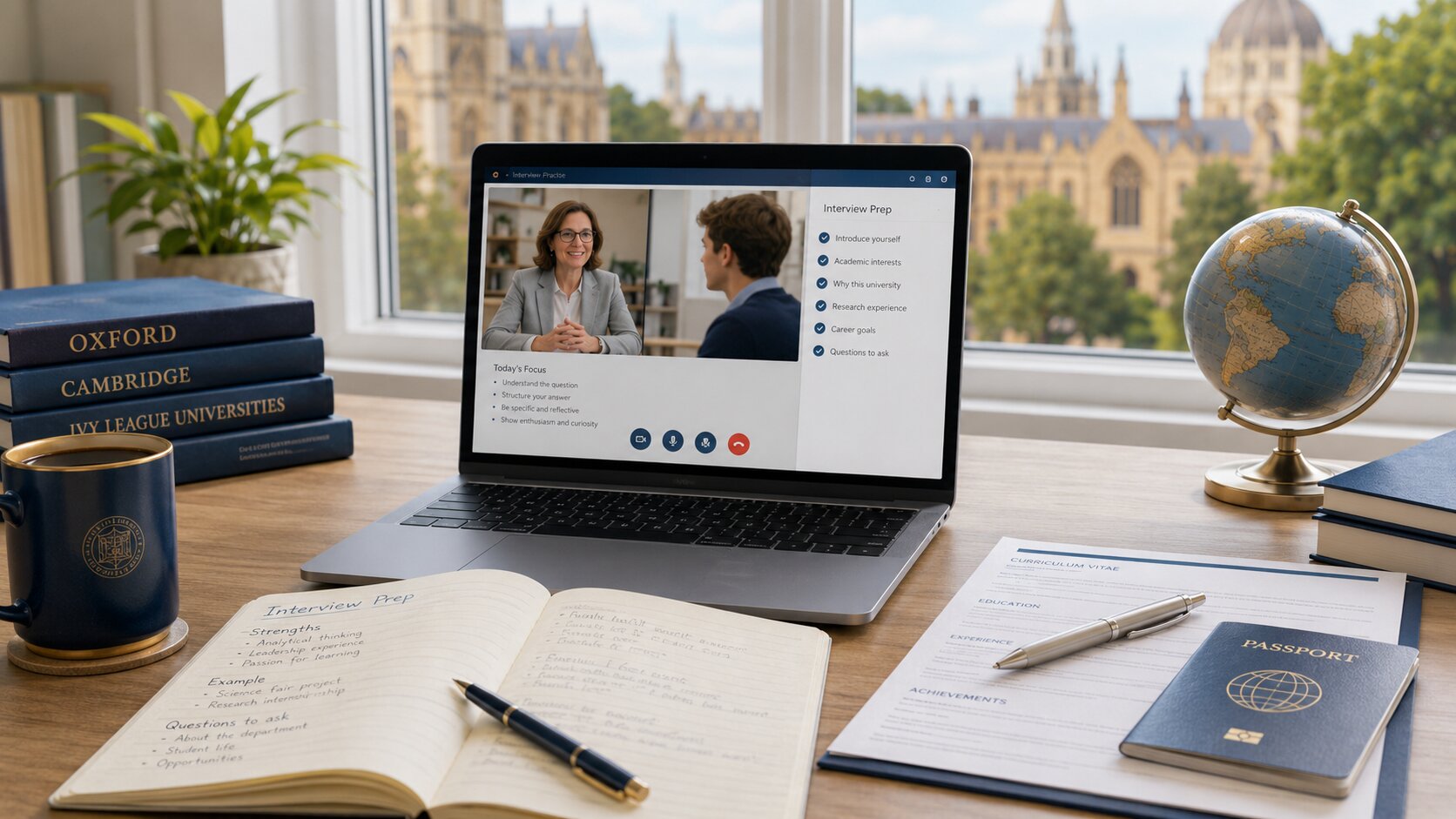
An interview at top international universities is one of the key stages of applying abroad. It shows not only the level of knowledge, but also how a candidate thinks in real time: how they explain ideas, respond to questions, and deal with unusual tasks.
High grades do not guarantee a successful interview. Many applicants have equally strong academic indicators, so the interview helps reveal differences in thinking and communication.
In this article: clear recommendations for interview preparation, sample questions, and practical advice.
Why Universities Hold Admission Interviews
Exams and grades show preparation, but they do not explain how a person works with new information. The interview fills this gap.
The admissions committee looks at:
- Interest in the subject and motivation;
- The ability to reason rather than reproduce facts;
- Clarity and structure of the answer;
- The ability to explain complex ideas in simple language;
- The ability to gather your thoughts, clarify, and develop an idea.
Often there is no single "correct" answer. What matters more is how the candidate reaches a conclusion.
Practice is a key stage of interview preparation.
If you want to analyze answers to real Oxford or Cambridge questions with a mentor, book a mock interview with AcademX.
How Interviews Differ at Oxford, Cambridge, and Ivy League Universities
The general goal of the interview is the same: to understand the applicant's way of thinking. The difference lies in how exactly this is tested.
What Questions Are Asked at an Oxford Interview
At Oxford, the interview is almost always built around the subject. The candidate is tested not on memorized knowledge, but on the ability to work with material in real time.
Applicants are often given:
- Analysis of a text or idea;
- A logical or analytical task;
- Discussion of a narrow question within the field.
The conversation develops as it goes. The interviewer clarifies details, makes the questions more complex, and observes how the logic of reasoning changes.
Features of the Cambridge Interview
The differences between Oxford and Cambridge are not systemic, but variable: both universities test thinking through subject-based questions and tasks.
A candidate may be asked to:
- Solve a problem with gradual increases in difficulty;
- Explain every step of the solution;
- Return to initial assumptions and test them.
Precision and careful reasoning are valued here, not only the final answer.
How Interviews Work at Ivy League Universities
In the Ivy League, the format depends on the university and program. In some cases the interview is required; in others it is recommended or conducted selectively.
For example, in certain programs such as architecture at Cornell University, an interview is almost always part of the selection process. In other cases, applicants are invited when the application leaves questions or when the committee wants to better understand the candidate's motivation.
Interviews are most often conducted by alumni, but admissions officers may also conduct them. The format is flexible: online, by phone, or in person, usually in neutral locations.
The conversation usually revolves around:
- Experience outside school;
- Projects and interests;
- Motivation and goals for applying to a foreign university.
What matters is not a list of achievements, but how they connect to the chosen direction.
The interviewer may disagree with your position. This is not an argument, but a way to test how you react to a different opinion. A calm argument is more important than trying to "prove yourself right at any cost."
Do you not know what your specific interview will look like?
An AcademX mentor will study your university, program, and level of preparation – and explain what to expect at the interview and how to prepare for it.
Who Conducts the University Interview?
The format depends on who conducts the interview. This affects the style of communication and the level of formality.
Interview With an Admissions Committee Representative
The interviewer participates in student selection and has access to part of your application.
In most cases, the admissions committee representative has full or partial access to your application. Most often this includes:
- Motivation letter or essays;
- Recommendations;
- Sometimes exam results and a short resume.
The goal is to check how well your story matches the application and to evaluate strengths and weaknesses.
Candidates are expected to provide:
- Explanations of achievements;
- An honest discussion of strengths and weaknesses, if any;
- A logical story of why the direction was chosen.
You can also ask questions about the program, internships, and the structure of study.
Interview With Alumni
This is a more flexible format. The graduate does not make the admission decision, but sends a report with impressions of the applicant.
This report may be taken into account when the application is reviewed, but it is not the determining factor.
The interviewer may not know the details of your application, so the conversation begins with basic introductions and general questions.
The candidate has an opportunity to:
- Talk about themselves without the pressure of a formal evaluation or fear of wrong answers;
- Explain interest in the subject;
- Emphasize strengths through experience, portfolio, and projects.
The interviewer evaluates not only the content of answers, but also the ability to maintain a dialogue; they also indirectly assess language skills.
Interview With Current Students
At some U.S. universities, interviews are conducted by student ambassadors.
The reason is simple: the application flow is too large for the admissions committee to process alone.
Students are selected and trained. Before the meeting, they receive basic information about the candidate. After the interview, they send their observations to the admissions committee. Formally, their opinion does not decide the outcome, but it may be considered.
The advantage of this format is the opportunity to see the university from the inside. Students can explain:
- How study is organized;
- What the campus atmosphere is like;
- How classes and life outside lectures work;
- What is not visible on official websites.
This is one of the most practical ways to understand whether a university is right for you.
How to Prepare for a University Admission Interview: Step-by-Step Plan
Create a clear preparation plan for the interview and break it into sequential stages.
Check the Format and Technical Requirements
Start with the invitation letter and the information on the website. It usually states exactly how the interview will take place.
For international applicants, the most common format is online:
- Zoom;
- Microsoft Teams;
- Google Meet.
Sometimes additional software installation or registration in the university system is required.
Check in advance:
- Which platform you will use;
- Whether account confirmation is required;
- Whether you have sent your contact details;
- Whether confirmation from the admissions office has arrived.
Book the Interview Time Without Delay
If you need to choose a slot during interview preparation, do not postpone it. Closer to the deadline, the choice is usually limited. If the slot is not confirmed, the interview may be moved or assigned automatically, depending on the university.
Respect the Interviewer's Schedule
If the interview is conducted by a university graduate, communication becomes more personal. But the rules are the same – this is part of the selection process. Pay attention to:
- How quickly you respond to messages;
- How accurately you keep agreements;
- Whether you are ready to accept reasonable time changes.
Do not:
- Insist on only one possible time slot;
- Reschedule the meeting several times;
- Delay replying to emails.
These details can also appear in the final report.
Prepare Questions for the Interviewer
At the end of the conversation, the interviewer often gives the candidate a chance to ask questions. This is not a formality, but another practical stage of selection.
Good questions concern:
- The experience of studying and living at the university;
- Extracurricular activities;
- First-year courses and workload;
- Advice for applicants;
- Research opportunities.
Do not ask general questions whose answers are already on the university website.
Practice the Interview With a Teacher or Mentor
It is useful to prepare a 30-60 second story about yourself in advance. You may not be asked directly, but it helps you start the conversation confidently.
It should briefly mention:
- Who you are;
- What you study;
- What interests you;
- Why you chose the direction.
Do not forget to practice with a mentor or teacher. This will help you answer questions more confidently.
Check the Technology and Workspace
Before the interview, test everything:
- Stable internet;
- Camera and microphone;
- Access to the platform;
- Device charge.
Check documents and deadlines. It is best to have the following nearby:
- Passport or ID;
- Pen and paper for notes.
Sometimes applicants are asked to show an ID to the camera for identity verification.
Choose a Neutral Appearance
For bachelor's admission, there is usually no strict dress code. A neat and calm appearance without bright distracting details is enough.
For most online interviews for master's admission, the dress code is informal or business casual. Requirements:
- Clean, neutral clothing;
- Minimum distracting details;
- Comfort that does not interfere with the conversation.
The main point is that nothing should distract from the conversation itself.
Practice the interview in conditions close to real ones.
Mock interview with a mentor in the format of your university
- Mock interview — Simulation based on real Oxford / Cambridge / Ivy League questions
- Written analysis — Targeted feedback on each answer and logic errors
- Preparation plan — Personal 2-4 week plan based on your level
More than 500 applicants have entered top-30 universities worldwide with AcademX
Conclusion
An interview at Ivy League universities, Oxford, and Cambridge is not a test of ready-made answers. The questions asked in interviews allow universities to assess thinking, logic, and the ability to maintain a dialogue.
Interview formats differ, but the principle is the same: it is not only your level of knowledge that matters; clarity, consistency, and the ability to think in the moment are evaluated.
Preparation for an interview at the university of your dreams consists of simple things: understanding the format, practicing answers, learning to talk about yourself without templates, and paying attention to organizational details. Practice plays a separate role – the more often you speak answers aloud and receive feedback, the easier it is to keep the structure of your thoughts in a real conversation.
Ready for an interview at the university of your dreams?
AcademX helps applicants pass interviews at Oxford, Cambridge, and Ivy League universities – from the first analysis of the format to a confident conversation with the admissions committee.
FAQ
What Questions Are Asked at Interviews?
In alumni interviews and at U.S. universities, applicants are often asked to briefly introduce themselves. At Oxford and Cambridge this almost never happens – there they move straight to subject-based tasks. Questions usually fall into several types:
- Motivational questions: why you choose this program;
- Subject questions: in your field;
- Analytical questions: logical tasks, situation analysis;
- Personal questions: experience, projects, interests.
Sometimes questions may be unexpected in order to see how you reason in a new situation.
What Is a Self-Presentation or Elevator Pitch?
At an interview, applicants are often asked to briefly talk about themselves. The wording "Tell me about yourself" can confuse even a well-prepared applicant. Usually the candidate is expected to give a short 30-60 second answer – this is the elevator pitch.
The essence of such an answer is simple: in a short time, show who you are, what you do, and why you are a good fit for the chosen program. It is important not to turn it into a detailed biography.
A good self-presentation is built around several key blocks:
- Who you are: education, field, current stage;
- Your interest: what led you to choose the major;
- Experience and strengths: projects, skills, cases, achievements;
- Goal: where you want to move next and why it is connected to the program.
The interviewer should clearly understand how your experience is connected to the program you are applying for.
I Want to Apply to a Foreign University. How Should I Behave During an Interview With the Admissions Committee?
The main thing is to behave as if you are at a consultation, not an exam:
- Remember the interviewer's name and use it in the conversation – this helps avoid awkward moments and makes communication more natural.
- Listen carefully to the questions. An interview is a dialogue, so it is important not only to answer, but also to catch the meaning and clarifications.
- Do not get stuck on difficult questions. One unsuccessful answer does not decide anything. Usually, the reasoning process and the way you react to stress or uncertainty are evaluated.
- At the end, thank the interviewer, ask your questions, and clarify next steps: decision timelines, additional stages, and organizational details.
- If you have the interviewer's contact information, often the case with alumni, send a short thank-you email. You can note that the conversation was useful and mention that you better understood the program and university.
- Speak confidently, honestly, and to the point. Do not try to guess the "right" answers – interviewers usually notice sincerity faster than memorized phrases.
